

You want the suite, the lounge, the fine dining, and the unforgettable views. Your bank account disagrees. That tension is exactly what luxury travel on a shoestring budget is designed to solve. The good news? Luxury is less about how much you spend and more about where you spend it. With the right tools, timing, and a few insider moves, you can access high-end travel for less than most people pay for a forgettable mid-range trip. This guide shows you exactly how.
Table of Contents
- Key takeaways
- Planning luxury travel on a shoestring budget
- Smart booking strategies for luxury trips on a budget
- Enjoying luxury amenities without overspending
- Common pitfalls that wreck budget luxury vacations
- Evaluating whether your trip actually delivered
- My take on the luxury vs. budget false choice
- Travel smarter with Itsyoworl
- FAQ
Key takeaways
| Point | Details |
|---|---|
| Timing is your biggest lever | Shoulder season travel cuts costs by 20-50% while keeping quality high. |
| Credit cards unlock free luxury | The right travel card gives you lounge access, upgrades, and credits at no extra cost. |
| Selective splurging beats wholesale luxury | Pick one or two luxury anchors per trip instead of trying to afford everything premium. |
| Compare net rates, not sticker prices | A higher hotel rate with breakfast and credits included often costs less in real terms. |
| Discipline prevents budget blowouts | Hidden fees on baggage, seats, and resort charges can erase all your savings fast. |
Planning luxury travel on a shoestring budget
Before you book a single flight, you need the right foundation. The travelers who consistently pull off cheap exclusive travel experiences are not lucky. They are prepared.
The credit card you carry matters more than you think
The single most underrated tool for affordable luxury travel is a travel rewards credit card. Not because of the points alone, but because of the access it buys. The American Express Platinum Card grants access to over 1,550 airport lounges globally, including Centurion Lounges and Delta Sky Club, all with complimentary food, drinks, and Wi-Fi. Capital One cardholders get free showers, full bars, and fitness rooms at Capital One Lounges worldwide. Citi offers Priority Pass Select and Admirals Club access on select cards, often with guest privileges included.
Here is a quick comparison of what each card network delivers:
| Card | Lounge network | Key perks |
|---|---|---|
| Amex Platinum | Centurion, Priority Pass, Plaza Premium | 1,550+ lounges, complimentary amenities |
| Capital One Venture X | Capital One Lounges, Priority Pass | Showers, bars, fitness rooms |
| Citi Strata Elite | Priority Pass, Admirals Club | Guest access, global coverage |
Pro Tip: Lounge benefits vary widely by card. Pick the card aligned with your most frequented airport or airline network to get maximum value from day one.
Beyond lounges, you need two more tools: a deal alert app like Google Flights or Hopper for tracking price drops, and a direct line to hotel loyalty programs. Sign up for free. The perks add up faster than you expect.
Smart booking strategies for luxury trips on a budget
Knowing when and how to book is where most budget luxury vacations are won or lost. The strategy is not complicated, but it requires deliberate choices.
Shoulder season is your secret weapon
Traveling in shoulder season reduces costs by 20 to 50% on flights, accommodation, and activities while the experience stays nearly identical to peak season. Late May through early June and mid-September through mid-October are the sweet spots for most European and North American destinations. The crowds thin out, the prices drop, and the hotels are still fully staffed and operational.

One critical move: book directly with the property during shoulder season. Aggregator sites often display outdated peak-season pricing, so calling or emailing the hotel directly gets you the correct rate and sometimes a complimentary upgrade.
Five booking moves that unlock high-end travel for less
- Target regional airports. Flying into a secondary airport near your destination often cuts flight costs by 30% or more. Pair that with a budget carrier and you have freed up serious money for the hotel.
- Use destination dupes. Instead of the Amalfi Coast, try Albania's Riviera. Instead of Bali, try Lombok. The scenery is comparable, the price is not.
- Compare net rates on hotels. A hotel charging $220 per night with breakfast, a $50 dining credit, and a guaranteed room upgrade can cost less in real terms than a $160 room with nothing included. True cost comparison requires factoring in all perks, not just the headline price.
- Stack rewards points for upgrades. Use credit card points for flights and hotel points for room upgrades. You are not paying for the luxury. You earned it.
- Book suites on weekdays. Hotels drop suite rates significantly on Sunday through Thursday nights when business travelers are not filling standard rooms.
Pro Tip: Sign up for the hotel's loyalty program before you arrive, even if you are a first-time guest. A quick email to the front desk noting a special occasion can trigger a complimentary upgrade that would otherwise cost hundreds.
Here is how the numbers can look when you apply these strategies:
| Booking approach | Estimated cost | Included perks |
|---|---|---|
| Peak season, aggregator | $280/night | Room only |
| Shoulder season, direct | $160/night | Breakfast + late checkout |
| Shoulder + loyalty upgrade | $160/night | Suite + breakfast + dining credit |
Enjoying luxury amenities without overspending
You have booked smart. Now the real skill is living luxuriously on the ground without watching your budget collapse.
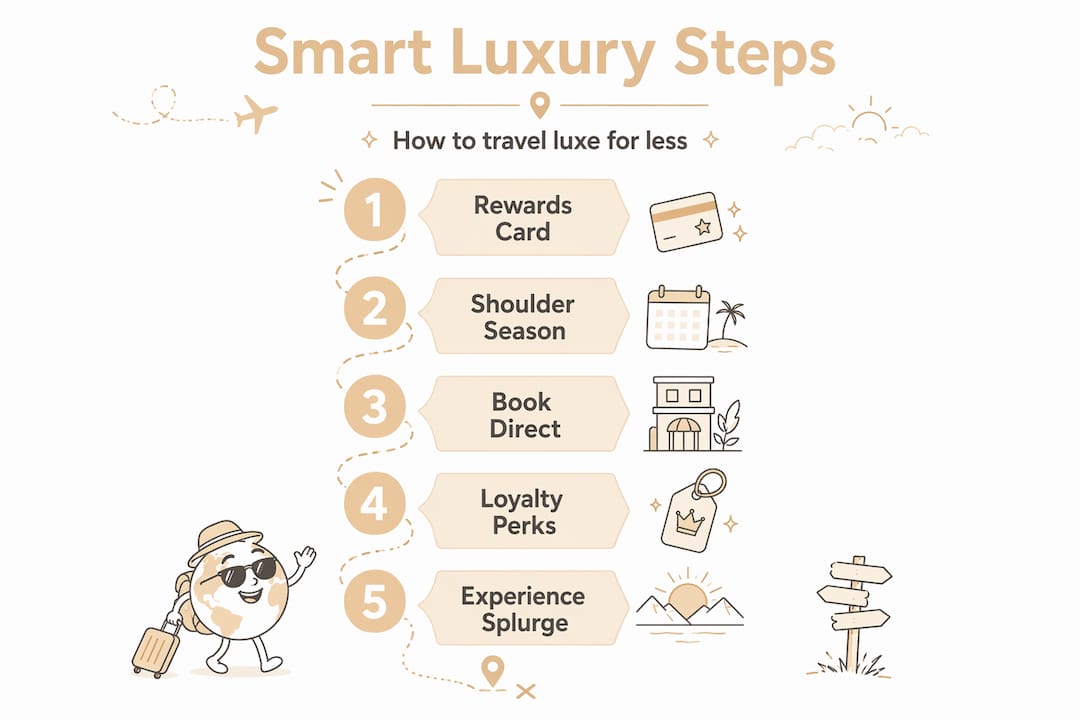
The core principle here is selective splurging. Luxury often boils down to one or two key anchors per trip rather than wholesale expensive bookings. Choose the one thing that will define the trip for you. A sunset dinner at a Michelin-starred restaurant. A one-night stay in a clifftop suite. A private guided tour of a hidden site. Spend generously on that. Be disciplined everywhere else.
Here is how to manage the day-to-day:
- Use your lounge access on travel days. Airport lounges provide luxury-per-hour value that costs far less than a business class upgrade but delivers a comparable comfort experience during layovers and delays.
- Eat strategically. Have a big hotel breakfast when it is included, grab a local lunch at a market or bakery, and reserve your dining budget for one excellent dinner. Happy hour at a rooftop bar gives you the atmosphere of a luxury venue at a fraction of the price.
- Contact local tourism boards. They often have free or discounted passes to museums, tours, and experiences that are not widely advertised. This is one of the most overlooked sources of cheap exclusive travel experiences.
- Pack light and avoid checked bags. A single checked bag fee on a budget airline can run $40 to $80 each way. That is money better spent on a spa treatment or a wine tasting.
Pro Tip: Book the "experience" version of luxury rather than the "accommodation" version when you are tight on funds. A $200 cooking class with a local chef in Tuscany is more memorable than an extra night in a four-star hotel.
Common pitfalls that wreck budget luxury vacations
Even well-planned discount luxury holidays can fall apart. Here is what trips up travelers who think they have it figured out:
- Resort fees. A hotel advertising $99 per night can charge $45 in daily resort fees on top. Always check the total rate, not the advertised rate.
- Baggage add-ons. Budget airlines price their base fares low and recoup costs through seat selection, carry-on fees, and priority boarding. Strict operational discipline on these extras is what separates a $100 trip from a $300 one.
- Overestimating "cheap" destinations. Southeast Asia is affordable, but if you are eating at tourist restaurants, booking western-branded hotels, and taking taxis everywhere, you will spend just as much as you would in Europe.
- Booking too early or too late. The sweet spot for flights is typically 6 to 8 weeks out for domestic and 3 to 5 months out for international. Outside that window, prices climb.
"The difference between a blown budget and a luxury trip on a shoestring is not luck. It is knowing exactly where your money goes before you spend it."
The travelers who consistently pull off luxurious travel deals are the ones who track every expected cost before they confirm a booking. Build a simple spreadsheet. Include flights, accommodation, food, activities, transport, and a 10% buffer. If the numbers work, book. If they do not, adjust the destination or the dates.
Evaluating whether your trip actually delivered
After the trip, the question worth asking is not "Did I have fun?" It is "Did I get the luxury experience I planned for, at the price I planned for?" That distinction matters if you want to get better at this.
Here is a simple framework for post-trip evaluation:
| Category | Planned spend | Actual spend | Luxury rating (1-5) |
|---|---|---|---|
| Flights | $300 | $280 | 4 |
| Accommodation | $150/night | $160/night | 5 (suite upgrade) |
| Dining | $200 total | $185 total | 5 |
| Activities | $150 total | $140 total | 4 |
| Lounge access | $0 (card perk) | $0 | 5 |
Track your rewards usage too. Did you use your points effectively? Did the lounge access deliver comfort on travel days? Did the shoulder season booking actually get you the rates you expected? Reviewing this honestly after each trip compounds your skills fast. The second trip is always smarter than the first.
My take on the luxury vs. budget false choice
I have seen a lot of travelers talk themselves out of extraordinary experiences because they assume luxury and budget are opposites. They are not. They are just different decisions about the same money.
What I have learned is that the most memorable luxury moments rarely come from the most expensive ones. A free upgrade at a boutique hotel in Lisbon because I emailed ahead and mentioned it was my birthday. A lounge in Istanbul with a full spread of food and a shower before a long flight, all covered by a credit card annual fee I had already paid. A shoulder season booking in the Algarve that cost me half of what my friends paid two weeks later for the same property.
The conventional wisdom that luxury requires a luxury budget is simply wrong. What it actually requires is preparation, timing, and the willingness to think beyond your perceived budget constraints. Most people do not do that work. That is why most people overpay.
My honest advice: stop trying to afford luxury everywhere and start choosing one or two moments per trip where you go all in. The rest of the trip can be lean. Those two moments will be what you remember.
— E
Travel smarter with Itsyoworl
You now have the framework. The next step is putting it into practice with tools and hacks that have already saved real travelers hundreds of dollars on trips they thought were out of reach.

Itsyoworl has built one of the most practical collections of travel intelligence available for budget-conscious travelers who refuse to settle for less. From 127 hidden travel hacks that cover everything from credit card stacking to upgrade triggers, to a focused list of hacks that save hundreds on real bookings, the platform is built for exactly the kind of traveler this guide was written for. You do not need a bigger budget. You need smarter moves. Itsyoworl gives you both.
FAQ
What is the best way to start luxury travel on a shoestring budget?
Start with a travel rewards credit card that includes lounge access and hotel credits, then book during shoulder season for 20 to 50% savings on the same high-quality properties.
How do I get hotel upgrades without paying for them?
Join the hotel's loyalty program before arrival, email the front desk to mention a special occasion, and book directly rather than through a third-party site. Direct guests receive preferential treatment far more often.
Are airport lounges worth it for budget travelers?
Yes. Lounge access through a travel credit card delivers comfort and amenities including food, showers, and Wi-Fi at no additional cost on travel days, making it one of the highest-value perks available.
What hidden fees should I watch out for on budget luxury trips?
Resort fees, baggage charges, and seat selection fees are the most common budget killers. Always check the total all-in price before booking, not just the advertised nightly or base fare rate.
What is shoulder season and when should I travel?
Shoulder season falls between peak and off-peak periods, typically late May through early June and mid-September through mid-October. Prices drop significantly while destinations remain fully operational and enjoyable.